How to Paint Fur – Tiger Tutorial
September 21, 2009 34 Comments
UPDATE 13th May 2013
As promised I have listened to your opinions and just completed my brand new eBook packed full of ADVANCED fur painting techniques and tutorials. The eBook is called “How to Paint Animals” and is available right now for instant download and also on a computer CD (for a limited time only)
Full details are on my wildlife art tutorial site or click the photo below 🙂

advanced techniques painting fur
From the Poll it appears that most of you would like to see more fur tutorials and tips, so here is an excerpt from an article I wrote in Artists & Illustrators magazine, if you didn’t see the article in the mag hopefully you will find this of use 🙂
It might appear that I painstakingly brush in each individual hair. But that type of painting can become very tedious, so I concentrate on just giving the impression of detail such as fur and hair.
I use fast-drying Winsor & Newton Alkyd Oil paints – which consist of pigment in oil modified alkyd resin – so there is minimum waiting time between drying stages. Whether you paint tigers, gorillas or poodles, the following stages will help you depict realistic fur…
Image number 2) This is the blocking-in stage. Paint the colour and tone deep down in the fur, the area you can see between all the surface hairs – it’s frequently a dark brown or grey. At this stage, don’t worry about details. Your aim should be to give the animal a solid structure. The details will come soon enough, and you will need something quite dark underneath them.

Image Number 3) This is really a mid-texture stage.
Remember: fur is made up of not just hair but also air. There is usually depth to it, so try to imagine what it would feel like as you paint it. This stage helps to create the appearance of depth and thickness to the fur – I frequently do it while Stage 2 is still wet. Use quite loose brushstrokes, especially when painting long fur, and try to detach yourself from thinking about where each stroke is going to go as you paint. If you think about it too much it can look regimented and unrealistic. Always paint in the direction of the fur’s growth.
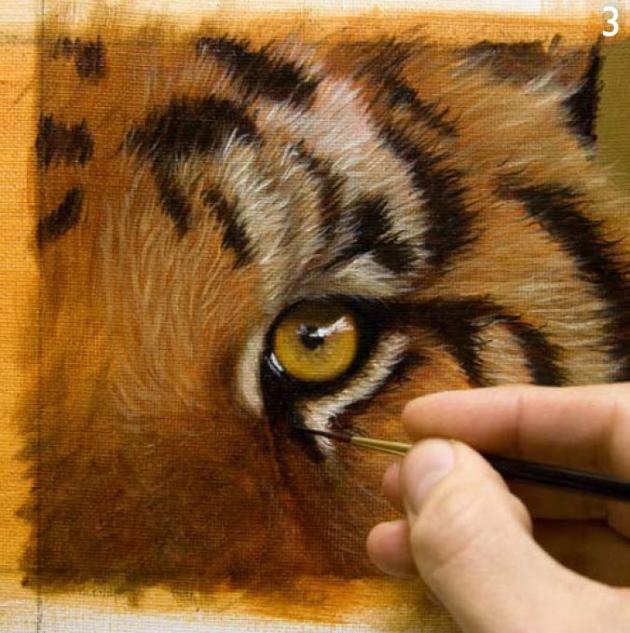
Image number 4) Complete this stage after Stage 3 has fully dried (essential if you are going to glaze). Begin by knocking Stage 3 back with a fairly dark glaze (a thin wash of colour). This then automatically becomes mid-depth fur. Then, when it is still wet, add the final details using a rigger brush. It’s surprising how few details need to be applied over the other layers to give the illusion of fur.

Image number 5) Refine the fur, glazing where necessary and adding a touch more detail here and there – in the case of this tiger, whiskers and the white hairs on the surface of the coat.

Hope you liked it and don’t forget to leave your comments 🙂
This Tututial is also in my brand new ebook with even more text.

You can download 2 FREE pages right now – PDF files


 About Jason Morgan - wildlife artist - Oils, pastel pencils and more



 How to Draw and Paint Animals - Wildlife Art Videos, Pastel pencil and oil painting Lessons
very generous lesson – and wonderful realistic painting
Thanks Lene 🙂
Gorgeous! You make it look so easy 😉
It’s not as hard it seems Carol 🙂
Thanks for the feedback
A very useful demo Jason – thanks!
I note that you’re using alkyd oil paints and that they’re fast drying, however, I can imagine circumstances where you might like to prolong the drying time at a particular stage of a painting. Is there a problem using alkyd and normal oil paints together on the same painting?
Thanks for your question Peter,
You can mix both types of paint, although I find that Alkyds on their own give me a long time for blending etc
Hi Jason,
Thanks for putting this up. Excellent info. I have some additional questions though.
I was wondering how you deal with the lean and fat rule in oil-painting since you mention a wash over previous layers. Also can you give some information about the consistency of the paint you use for whiskers? I always have trouble with these long, clean curvy lines, even with a rigger brush. The paint just doesn’t flow from the brush and when I thin the paint to improve the flow it becomes too transparent.
How fast do you paint 1 whisker, is it a quick swoosh of the brush or do you slowly drag the brush along the surface.? Hope you have some tips because these are the things that you normally don’t read in tutorials.
Good questions Erik,
I use Alkyd Oils which dry quite fast and hard, and currently I thin my paints with an Alkyd type thinner (I’ll find out the make and post here), similar to Liquin, this improves the flow when required, I’m not using any other oils etc so I think that takes care of any fat over lean type stuff. I honestly don’t worry about that stuff too much myself.
If I need the paint to slip / flow even more, eg when painting whickers, I will also add a little odorless paint thinners to the miox. So to paint a whisker I would get some paint (white for instance) dip my brush in alkyd thinners, mix it a bit, then dip my brush in a little odourless thinners and mix that in too. There is a fine line between too little and too much, which as you have found, causes the transparency of the paint.
Practice is the only way to really know.
I paint a whisker in one movement, at a moderate speed approx 1 second to do 5-6 inches. Sometime, but not always I will need to carefully go over the whicker a 2nd time to make it nice and opaque (let the 1st layer dry 1st).
One important thing to consider is the texture you are painting on, ie if you are using a rough grade canvas it will be VERY difficult to get a nice even flowing line, when compared to a finely sanded board for instance. I use a fine grade canvas – often called a portrait canvas. To make it even finer you could paint an additional layer of gesso on top, let dry fully then sand with some very fine sand / glass paper.
Hi Jason, that really helps. Thanks for explaining that so thoroughly. It makes perfect sense.
Best wishes, Erik
I don’t know If I said it already but …This blog rocks! I gotta say, that I read a lot of blogs on a daily basis and for the most part, people lack substance but, I just wanted to make a quick comment to say I’m glad I found your blog. Thanks, 🙂
A definite great read..Jim Bean
I can see that you have starting posting at a higher frequency that before and what better than to share your knowledge with your followers.
Kudos to you on this grand initiative of sharing your technique and knowledge.
Its a coincidence that my latest post is on Tigers as well, The Royal Bengal Tiger that I found in Bandipur, South India.
Thanks Thomas,
I’ve had a lot more replies and feedback from my blog visitors lately, which makes it nice and personal 🙂 makes me want to post and talk more – Watch out for my new commission another tiger but this one is VERY dramatic, will post soon
Your site was extremely interesting, especially since I was searching for thoughts on this subject last Thursday. 🙂
hello Jason, I have just ‘found’ you and your paintings are beautifull.
I live on a small Island in the British Channel, Jersey, smaller than Disneyland in Florida!
I have always wanted to be an ‘artist’ and to paint and paint and paint, but life took over and now i find myself a ‘”Nanny darling” to a little granson who i look after during the week and wouldn’t be with out.
I paint when i can for myself and now and then paint pet portraits for pocket money.
Last year i painted a tiger to see if i could, i like to test myself and dream of being able to paint as realistically as you. I use acrylics as they are cheaper than oils and dry quicker, though i am now aware of quick drying oils and aim to get some in the future. I was/am happy with my tiger though having now seen your step by step ‘tiger eye’ i can see that i can get more realism by maybe painting a wash over the top and layering even more hairs on to the existing layers, i forget how many though i seemed to be darkening then lightening for ever! My grandson goes to school next year so i plan to paint in my freed up time before i cant see to do it! My dream would be to see something i had painted ‘in print’ and that means first painting something i feel i cannot better, never mind the mine field that would be the next stage.
It may be of interest for you to see what your ‘followers’ are up to, not that i imagine you have much free time either, but it might be nice if people could take your advice then ‘post’ the ‘before’ and ‘after’ etc and it seems to be that all, or most, ‘artists’ love to see others progress.
Thankyou again for your generosity and i look forward to every update from you.
Kindest Regards and Thankyou again for the ‘insights’ and knowledge you share.
Thank you so much for your post Fay.
You might have a long wait for your prints if you are waiting to do a painting you can’t improve upon – I’ve NEVER done one myself yet! Ha…..
It’s great to have insight into people following my step by steps, I always love to see what everyone is creating.
Jason
Hello Jason, I recently discovered you and you are awesome!. I have always dreamed of being an artist, 2 yrs ago at the age of 50, I finally started painting by taking saturday classes (informal ones) at a community college. Although this is not real art school, there is some direction and I am in heaven! as I tell my husband and my teenage son, this is my time, I am leaving my dream. Maybe someday I can do a good painting. My first love is animals, mostly wildcats birds and the sea. You don’t know how much I appreciate your tutorials. I just got myself in a compromising position by trying to paint a leopard from a photo I took. I currently use water soluble oils. I think that with a lot of faith, very hard work and using your tutorial on fur painting techniques, I might pull it off! (maybe…) thank you so much for sharing with all of us who are so hungry for learning and cannot afford to go to art school. You are a blessing!
Thanks so much for posting – really appreciate your kind comments and goodluck in your artistic future!
Jason
hi jason you are one of the best wildlife artists in the world and i realy luv your work. i alredy purchsed both editions of your ebooks and thanks for those wonderful hard to get lessons.
what i really ask is i wouldnt mind buying video lesson from you-whatever the price.please i really need those video lessons and i believe all these wanna be artist also need them
Thanks,
I have purchased a HD camcoredr so I am all set up to do some instruction video.
I just need to make the time to actually do them!
All the best
Jason
thanks jason. all the best
Hi Jason,
Your work is exquisite. I really appreciate you taking the time to post the fur painting tips. When I look at your work, I can imagine you taking hour after hour painting each individual hair on the tiger. The eye of the tiger in the illustration appears to almost have my own reflection, it’s so realistic.
Thanks
Wow thanks Randy and my pleasure.
I don’t take that long doing the fur, it’s just an illusion really I guess 🙂
Jason
thanks for doing this tutorial, I found it really useful and insightful. I’ll be back for more.
My pleasure Lance
Thanks for this, having just started a Tiger face myself and being a beginner It’s just what I was looking for!
Glad you found it of use, more free demos here http://www.jasonmorgan.co.uk
beautiful colors you did not list i am attemting to do a tiger now and your close up is very good
hallo jason im luca from rome i like to paint but please about tiger for me is difficoult because i have problem with canvas i use normal canvas and befor to paint i prepare it with 3 layer of acrilic paint its all then i use sundpaper and i begin to paint but for the landscapes no prblem but for the tiger is almost imposible to give lucidity at the paint the colour becam opaque after some hours because the fur is very different from landscape for exemple . i hope in your soon repaly in simple words thanks my champion my children love you . bye
please sorry i dont speak english so good . no problem . if posible im waiting for a reply . mister jason please replay me if posible if no posible thanks the same and you are for me the best however .
It is a good tutorial what I’m looking for. Thanks a lot.
Dear Mr.Jason,
I’m painting a tiger now.. But I have problem when I want to paint its flur..I just wondering how’s the best way to paint tiger’s flur more fastly but realistic.. Could u please help me to give me some advice for it Mr.Jason? Am I have to paint tiger’s flur one by one for tiger’s whole body? It will take so much time if I have to paint one by one..
Anyway r u books has import in indonesia country which is state in north Sumatra? I would like to buy your books Mr.Jason to learn painting.. Coz I saw ur painting so amazinggggg…
Thanks & Best Regards,
Puspa Dewi
check out my tutorial site http://www.jasonmorgan.co.uk for free tiger painting demos
Your oils are amazing. I have been trying to paint a Siberian Tiger for a week now and could not figure out the fur..this tutorial has really helped a lot. Thank you so much for sharing your talent with us. You have been give a true talent, and to share it so freely makes it even more special. Thank you again and God Bless.
My absolute pleasure Joy. Wish I had more time to show more step by steps 🙂
Jason